Sewer Line Repair in East Flushing, Queens
When recurring backups, gurgling basement drains, or pungent sewer odors threaten your East Flushing home, our licensed underground drainage specialists utilize fiber-optic camera diagnostics and targeted spot repairs to restore free-flowing discharge.
Slow Drains, Recurring Backups & Sewage Odors
A sewer line backup is among the most disruptive emergencies a Queens property owner can encounter. In neighborhoods like East Flushing, where mature oak and maple trees line residential parkways near Kissena Park, tree roots relentlessly seek moisture through underground pipe seams. When the main building drain clogs, sewage has nowhere to go and surges backward out of the lowest plumbing fixtures—typically basement slop sinks, shower stalls, or floor drains.
Unlike an isolated kitchen sink clog that requires localized professional drain cleaning, a sewer line issue impacts every fixture in the home simultaneously. If flushing an upstairs toilet causes wastewater to bubble up into your basement tub, your building's primary underground lateral is severely compromised and requires immediate professional evaluation.
Root Intrusion & Aging Clay or Cast-Iron Piping
Much of East Flushing's residential housing stock was built during the early to mid-20th century. During this era, underground sewer laterals were constructed using either extra-heavy cast-iron pipe or vitrified clay tile segments joined by mortar:
- Vitrified Clay Tile Degradation: Clay pipes are naturally brittle and joined every three to five feet. Over decades, ground shifting and vibration loosen mortar joints. Fine tree root hairs penetrate the microscopic seams, expanding into dense, wire-like root balls that snag toilet paper, waste solids, and grease.
- Cast-Iron Channel Rot & Scale: Heavy cast-iron sewer piping eventually suffers from bottom-channel rot, where acidic wastewater erodes the bottom pipe wall over fifty years. Heavy internal rust and tuberculation scale catch solids, reducing the effective interior diameter from four inches down to less than two inches.
Property Owner Responsibilities Under NYC DEP Regulations
A crucial fact many Queens homeowners do not realize until an emergency occurs is that the New York City Department of Environmental Protection (NYC DEP) holds the private property owner legally responsible for the entire sewer lateral. This responsibility extends from the house trap inside your cellar, across your front lawn, underneath the public sidewalk, and through the street roadway to the city sewer main connection.
High-Definition Sewer Camera Inspections
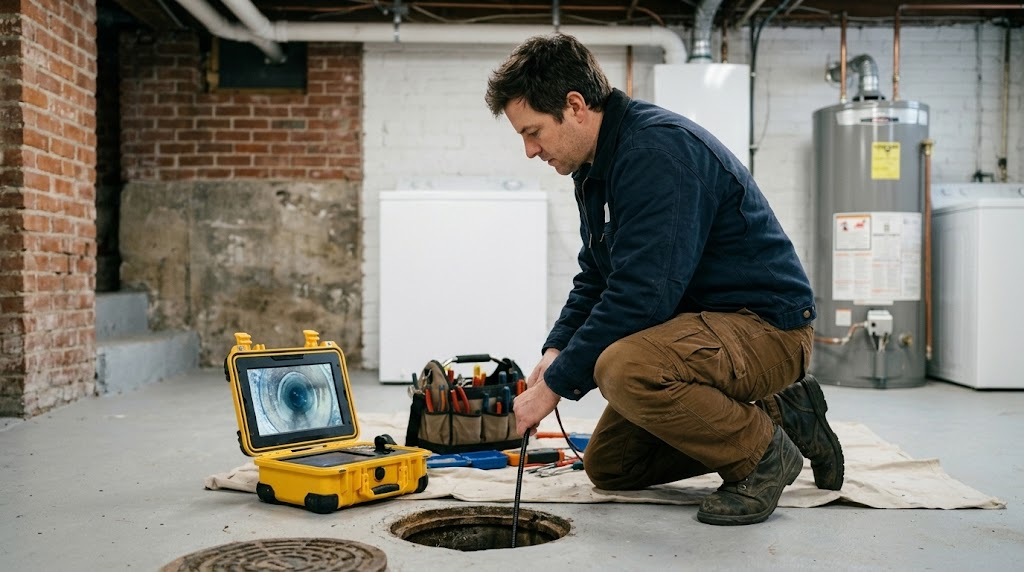
Guessing where an underground pipe has failed causes unnecessary excavation and costly property damage. Our sewer specialists insert an industrial, self-leveling fiber-optic camera equipped with a high-frequency radio sonde transmitter directly into the sewer line. As the camera travels down the line toward the street, it displays crystal-clear color video revealing:
- Exact location and severity of invasive tree roots.
- Cracked, sheared, or collapsed pipe sections.
- Belly sags where standing water collects waste and causes recurring blockages.
- Condition of the building house trap and fresh air inlet.
Above ground, our technicians trace the sonde signal using an electronic receiver, marking the exact spot and depth of the fault on your driveway or lawn to within inches.
Spot Repair vs. Complete Lateral Replacement
Once camera diagnostics confirm the exact nature of the failure, we outline appropriate repair strategies:
- Precision Spot Repair: If 85% of your sewer lateral is structurally sound and the failure is isolated to a single crushed connection or tree root break, an open-cut spot repair is the most economical solution. We excavate only the damaged section, replace it with durable schedule 40 pipe, and install heavy-duty shielded mission couplings.
- Full Lateral Replacement: If video inspection reveals continuous channel rot, multiple collapsed joints under the roadway, or pervasive structural failure, full replacement ensures permanent reliability and prevents recurring street excavation costs.
Protecting your basement from groundwater and municipal main surcharges also involves secondary defense systems; learn how our sump pump and flood protection solutions safeguard Queens basements.
When a Sewer Backup Requires Urgent Attention
Raw sewage poses severe biological health hazards, containing bacteria, pathogens, and combustible methane gas. If sewage is actively spilling onto your basement slab or backing into heating appliances like your water heater or boiler, discontinue all water usage immediately. Shut off appliances and contact our emergency dispatch to diagnose and clear the line safely.
Frequently Asked Questions About Sewer Line Repair
Under New York City Department of Environmental Protection (NYC DEP) regulations, the property owner is entirely responsible for the maintenance, repair, and replacement of the private sewer lateral from the building foundation all the way out to its connection at the city sewer main under the public roadway.
A specialized, waterproof fiber-optic camera with high-intensity LED lights is guided through the cleanout or building house trap into the underground lateral. It broadcasts real-time high-definition video showing the exact location and depth of root intrusion, cracked pipe sections, belly sags, or collapsed clay tiles.
A targeted spot repair is recommended when video diagnostic inspection proves that the sewer structural damage or tree root penetration is localized to a single short section of pipe, while the remaining runout consists of sound, properly pitched cast-iron or vitrified clay.
Warning signs include water rising out of basement floor drains or utility sinks when toilets on upper floors are flushed, loud gurgling noises from fixtures, slow drainage across multiple bathrooms, and foul sewer gas odors near the building trap.
Schedule an Underground Sewer Camera Inspection
Pinpoint sewer breaks, root clogs, and structural cracks without unnecessary digging. Call our Queens drainage team today.